We believe in UCU democracy for all members and think that UCU's democratic structures can be improved. If you agree with us and want open, transparent decision-making for all UCU members, please read our posts below.
The decision by HEC on Friday 17th March not to consult UCU members on the UCEA and UUK offers on Four Fights and USS – despite an informal 48-hour e-survey of members and BDM held the day before both showing majorities favouring consultation – has caused consternation and a storm of social media criticism of the General Secretary, of the way the e-survey and acrimonious BDM were conducted, and of HEC.
HEC’s decision raises issues that are fundamental to union democracy. Without going into whether the UCEA and UUK offers should be accepted or rejected or the arguments over the design of the e-survey questions and how the BDM was used to (as HESC motions put it) “give a steer” to HEC, we believe UCU members have the right to know how their elected representative on HEC voted on this crucial question regarding consulting the membership. Therefore, for the sake of transparency, democracy and accountability, we – that is those supporting the Campaign for UCU Democracy – publish below how we understand individual members of HEC voted.
First though, here is a reminder of the results of the e-survey and BDM. Individual members and branch delegates to the BDM were asked to answer “Yes” or “No” to the following question:
“Do you support UCU members now getting a vote on the negotiated proposals that have been reached, and pausing strike action (ASOS would continue) whilst this consultation takes place?”
Informal e-survey results
Turnout: over 36,070 members voted, that is around 50% of HE members.
67% were in favour of consulting members
33% were opposed to consulting members
BDM results
52% were in favour of consulting members
32% were opposed to consulting members
16% abstained from the vote
HEC was advised by Jon Hegerty, UCU’s Head of Bargaining, that if they voted for a formal consultation, members would be balloted separately on the USS and 4 Fights disputes; and was then invited to vote on the following question:
“Should the proposals agreed with UCEA and UUK relating to the USS and Four Fights disputes be put to UCU HE members in a formal consultation?”
HEC Votes for HE Member Consultation on UCEA and UUK Offers
To those who follow NEC elections carefully and who have read An un-common guide to UCU’s NEC elections, factions, slates and independents, it will be apparent that the “For” column consists of those elected from the UCU Commons and UCU Agenda/Independent Broad Left slates plus one independent, Lena Wånggren, while the “Against” column consists of fourteen members of the UCU Left faction plus eight UCU Left-leaning independents (“UCU Left-Lite”, perhaps). The “Againsts” also include at least six (Sean Wallis, Saira Weiner, Bee Hughes, Mark Abel, Matt Perry and Julie Hearn)[1] current or past members of the Socialist Workers Party which set up and controls UCU Left – see UCU Left, the Socialist Workers Party and National Executive Committee Elections.
A more detailed account of the e-survey and BDM, the UCEA and UUK offers and the HEC meeting, including a copy of the advice given to HEC by Jon Hegerty and motions they will submit to HEC on March 30, has been provided by UCU Commons members of HEC and can be found here.
An open letter has also been produced by UCU members of Campaign for UCU Democracy and UCU Commons, calling for member consultation on the UCEA and UUK offers on pay and conditions and the USS pension respectively. Those minded to call on HEC to offer member consultation on the offers may wish to sign it.
[1] Note: Grant Buttars was mistakenly included in the original list of current or past SWP members above. Grant is in fact a member of Revolutionary Socialists of the 21st Century (rs21), which was set up by former members of the SWP after the 2012 Comrade Delta affair (Kelly, John. Contemporary Trotskyism:Parties Sects and Social Movements in Britain. Abingdon, Oxon: Routledge Taylor & Francis, 2018: p.68), but has never been a member of the SWP. My apologies to Grant for the misunderstanding.
UCU Open Letter: HEC to Consult Members on Employer Proposals Now
We, the undersigned UCU Higher Education (HE) members, call on UCU’s Higher Education Committee (HEC) meeting on 30 March to consult with HE members on whether the current employer proposals on pay, terms and conditions, and USS pensions are sufficient to settle our current disputes and/or suspend/call off future industrial action.
The consultation, in the form of an e-ballot, should include several questions. For example, it should include separate questions asking whether members are in favour of accepting or rejecting UUK’s offer on USS and UCEA’s offer regarding the Terms of Reference for joint union/employer reviews of pay, contract types, workloads and pay gaps. In this way, the two disputes can and should be treated, and consulted on as individual, separate disputes.
The consultation should also ask whether members would support the suspension of further industrial action whilst time-limited negotiations are conducted.*
We would also ask that the HEC makes a decision that reflects the preferences of UCU members. Members take industrial action, and it is members’ views that should determine our industrial action policy.
*Please note: if you sign, only your name, title, Department/School/area and workplace will be shared in the list of signatories below. Note: we have cut the line ‘i.e. whether they favour the “bank and build” approach outlined by the General Secretary’ as it is not crucial to the aims of this open letter and motion, the latter of which is calling for a neutral presentation of the UCEA and UUK offers.
TLDR: Michael Carley outlines two opposing visions of union democracy, “representative” and “direct”. I explain here why I think this is a false dichotomy, that the essence of union democracy ought to reflect the broadest possible participation of members in decision-making, and that representative structures which do not exhibit high levels of member engagement cannot claim to be truly democratic. I also examine recent Higher Education Committee (HEC) and National Executive Committee (NEC) minutes to uncover some of the recent power struggles taking place among UCU’s governing bodies and figures.
Amid the tempestuous few days following the decision to pause strike action on the basis of Advisory, Conciliation, and Arbitration Service (ACAS) talks continuing between the employers’ body, UCEA, and UCU, various bloggers have had their say on the union’s rules concerning this pause and the agreement that has been struck between employers and the five Higher Education (HE) unions (UCU, UNISON, Unite, EIS and GMB). Of these a few consider the necessity or value of such a pause in light of the employers’ agreement, and the stakes and, indeed tensions, concerning different approaches to union democracy.
For the purposes of this piece, I want to focus on a recent blog by Michael Carley, in which he considers two contrasting interpretations of what a “member-led” union means. In responding to this welcome contribution to the current debate, I will aim to tease out some nuances with respect to “member-led” democracy and some other terms, “representative” and “participatory” democracy, while touching on wider points concerning union strategy, mobilization and member engagement. I also examine recent Higher Education Committee (HEC) and National Executive Committee (NEC) minutes to uncover some of the recent power struggles between UCU’s NEC/HEC and the General Secretary (GS) which feed into the debate about “representative” and “direct” democracy.
“Representative” vs “Direct” or Narrow vs Broad Participatory Democracy
In his recent blog post on member-led democracy, Michael Carley outlines two competing visions of how unions like UCU interpret the term “member-led”, with it roughly carving up along the lines of “representative” and “direct” democracy. Carley offers this brief summary of the preferred modes of different wings of UCU:
UCU Left favour decision-making through the union’s democratic structures, as informed by branch meetings and Branch Delegate Meetings, which give a steer to the national bodies which have the responsibility for decisions; UCU Commons and Independent Broad Left favour using consultations with all members in a sector, usually by individual electronic ballot, to inform decisions. Both approaches have their merits, depending on your view of what a trade union is, and how it should work.
What Carley’s and UCU Left’s overviews do, however, is present these modes as binary, or near-binary, oppositions. This need not be, and often is not, the case. For instance, most groups who favour member e-consultation, generally do not see this as a replacement for branch meetings or debate. Even if say a branch e-poll is given primacy over a vote held in a branch meeting, it will typically be done on the grounds that the numbers of members completing the poll far outweigh the numbers of attendees at a branch meeting. Polls can also inform branch meetings. Hence when say 3-5% of branch members make it to a meeting, but a poll shows what around 30-35% of the branch members think, decision-making within the branch is strengthened by evidence of the general lay of the land.
From this perspective, use of e-consultation is rather a supplementary form of participation, not a dislocated plebiscitary exercise, which ensures activists (who usually turn up to branch meetings, demos and picket lines) as well as rank and file members have their say. E-consultation then from this lens really ensures broad participation in union activity beyond the small coterie of activists that tend to lead branches. What UCU Left tend to advocate for is a form of democracy that prioritizes the views of those – to borrow from Lin Manuel Miranda – in the room where it happens.
In doing so, they cut out the views of those outside the room and who don’t or can’t attend branch meetings. In an age where accessibility is rightly given pride of place, we might pause here to think why any group would champion a form of union democracy that excludes those who are unavailable for a meeting for whatever reason. Given the stretched workloads, busy timetables, care responsibilities and access needs of staff in HE, why wouldn’t we make the terms of union debate available to those outside a meeting?
Carley goes on to imagine the union in terms of branches and individuals and makes a strong defence of branches as repositories of “collective” organization over that of “atomized” individuals – championing branch democracy, a “representative” model over a “direct” one. The notion that branches represent collective organization in contrast to individual members, who are atomized suggests that when I think as a member, free from branch influence, I am an isolated individual, but when I act within branch structures, I represent the collective. Can individual members not also have a collective mindset? Individualism need not necessarily lead to a low-risk, self-centred mentality in which one shops around for the equivalent of the cheapest car insurance. Perhaps we should begin rather to re-frame the binary debate not in terms of representative vs direct democracy (or participatory vs plebiscite), but rather in terms of narrow and broad participatory democracy. If I have to choose between the two, I will opt for the latter every time.
When “Representative” Democracy is Not “Representative”
In part, Carley’s piece presents a not-so-veiled critique of the GS: too often, it is implied, she has bypassed the democratic structures of the union, namely the NEC and, by extension, the branches. To illustrate his point, he provides the example of when on 30 January the GS emailed HE members to participate in an online ballot to reject the pay offer made by the employers after the HEC had chosen not to put the offer to members, because it believed the offer insufficient.
To read the GS’s poll as an undermining of HEC decision-making is an over-determined reading of two approaches that were not discrepant; it also misses the over-arching strategic advantage of putting the employers’ offers to members (even when union leaders do not recommend their acceptance). The GS encouraged members to reject the offer in line with the HEC’s decision – in no way undermining the HEC. Some might have read this as an unnecessary risk or indeed “a distraction” as I recall one UCU HEC member saying, which could have potentially undermined the HEC’s decision. However, the key thing the GS wanted to anticipate and defend against was an easy offensive from the employers’ body, UCEA, that the offer had not been put to members. She did this, some might say by the backdoor, informally, but in doing so she shored up the union’s position against oncoming salvos.
In conceiving of branches as places of collective organization and extending this idea or metaphor to national democratic processes of the union, Carley presents us with an ideal that sounds great in theory, but which has not proven great in practice. In contrast to the critique of the GS’s attempts at direct democracy, we do not hear about what happens when “representative” democracy ceases to be “representative”.
The minutes for the HEC’s 3 November meeting make for interesting reading on this score – as we now have a little more insight into the HEC’s vote for indefinite action – a vote which proved to not be backed by branch delegates, members’ representatives. 3.16 of the minutes note Robyn Orfitelli’s objection to legal advice on the grounds that “it had not been offered to her or HEC at an earlier point”, while 3.17 shows the motion for indefinite action was carried in spite of a note “that members have not been consulted on this strategy”. Here, to my mind, is a clearcut case of when “representative” democracy failed the union in practice. Legal advice and evidence of member support for the strategy were dismissed in one foul swoop.
It was the HEC’s catastrophic misjudgement of both the union’s ability to sustain and members’ support of such action, which led to the GS proposing an alternative 10-day escalating strategy for members to vote on at a branch delegate meeting (BDM) on 10 January 2023. The results showed 57% of branch delegates supported Grady’s strategy. Here, she had challenged the union’s democratic structures and gone to members, but she had done so on good grounds. The HEC had opted for a radical course of action, ignoring the principle of accountability to the broad membership. In doing so, the HEC had ceased to be “representative” – a point currently glossed by UCU Left reportage, which makes no mention of the 2:1 preference among branch delegates for escalated action, but rather misleadingly pitches indefinite action as a battle of wills between the HEC, who voted for it, and the GS, who opposed it. In this instance, “direct” democracy was the best recourse to put HEC members in touch with real rank and file views; nevertheless, while the GS made her appeal to members directly, she actually relied on a system of “representative” democracy – as BDMs rely on branch delegates – to report back, hence used two participatory models.
Many may recall the release of the GS’s escalating strategy via Youtube video on 14 December and wonder about her rationale for this step. On the surface, this might be read as evidence of the GS’s undermining of the NEC (albeit on the grounds that the broad membership could have its say). UCU Left’s website describes it as a “wholly undemocratic” intervention. Yet, there were clear tensions at work here, a backstory of the NEC’s attempt to muzzle the GS albeit in a surreptitious, almost imperceptible way. Few may have understood the inference near the start of the video, in which Jo Grady mentions that due to an NEC decision she “no longer provide[s] an in-person update” to the NEC. What did this mean? In short, the NEC had decided back in 17 June 2022 that it did not want to hear her reports in person, but wanted them recorded in advance – in essence cutting down her talking time within the meeting while making her available for questioning. The ostensible reasoning for this in the NEC motion that passed concerned time saving measures. It’s possible of course that some in the room voted for the motion in good faith, believing it a helpful time-saving measure; nevertheless, this manoeuvre does not look entirely innocent either, and betrays a broader struggle for power taking place between some NEC members and the General Secretary, whereby the former have sought to clip her wings.
In the penultimate paragraph of his 18 February blog on “member-led” democracy, Carley makes a veiled comment on the process by which the “pause” was brought about: “this week, NEC members have supported the decision to conduct negotiations with employers without consulting the people branch delegates [elect] to negotiate for us”. This sentence says a lot without appearing to. He correctly assesses the issue which has prompted outrage this and last week: that the GS, Jo Grady, and President Elect, Justine Mercer chose to suspend action to see through talks in concert with the four other HE unions. He is undoubtedly right to ask (without actually asking) why other JNCHES negotiators were not consulted, and to pose this question to members. However, if the inference is that this is an injustice to branch organization which undermines “representative” branch power this is debatable. In the annual HE sector conference, for example, held around May/June, voting branch delegates elect four of the JNCHES negotiators (the other four comprising the HEC chair, two HEC vice-chairs, pre-92 and post-92, secretary of HEC/UCU), but few if any branches that I know of give guidance as to which negotiator a branch delegate should choose – with guidance generally only given, if at all, concerning certain key motions important to the branch.
The process by which we elect negotiators at special sector conference is more likely to come down to whoever happens to be in the room – whether it is someone trusted by the branch, or the person who says “yes” and is willing to give up a day or two to sit, listen and vote on a series of motions. The point is the system by which we elect these four negotiators is reduced to a few hundred selected branch members, instead of the several thousand members it could be opened to. It seems appropriate to define this difference as not so much between “representative” and “direct” democracy, but rather between narrow and broad participatory democracy.
Fixing the Root Cause: Towards Higher Member Engagement
One of the reasons UCU’s national committee members may not always be so “representative” of rank-and-file members may be in part due to the low turnout of UCU members in NEC elections. In the 2021-22 UCU trustee, officer and NEC elections turnout was 7.9% – roughly a quarter of the underwhelming turnout of the 2021 England and Wales police and crime commissioner elections. In this context, then, it is not hard to see why the union’s democratic structures are populated by many people who either do not represent, or who are not necessarily interested in, the “mass line” or broad view of members. At the more local level, branch general meetings are often attended by only a small proportion of members – typically only scraping over the minimum number for quoracy, sometimes failing to do so – with branch committees rarely elected (since there is almost never competition for places). If “the union’s structures… informed by branch meetings” are to be taken seriously (as an alternative to direct consultation) then we need to ensure that they actually involve the broad membership in some way – if not inside the meeting, then outside – with e-consultation just one tool to do so. If we had higher member engagement in branch structures and NEC elections, and more democratic openness in terms of what happens in UCU’s various national, cross-sector, regional and branch committees, then we might get stronger representative democracy; e-consultation itself, while allowing individual members to be heard and avoiding activists speaking over the heads of the collected membership, might also be used to mobilize members on specific issues. Indeed, to some extent, paper balloting of members at periods of getting the vote out – comparable to e-balloting if more labour intensive – often does exactly this.
As one colleague recently put it, it’s possible our focus on differing interpretations of “member-led” democracy centres too much on the symptoms and not the cause – the cause being too few UCU members engage with UCU’s democratic structures in the first place. If, then, we really want to fix the democratic deficit within the union, then it’s this – member engagement in UCU’s democracy – that should be a top priority. E-consultation is certainly part of the equation for fostering broader membership engagement, but it cannot be the whole story. We need to look at UCU structures, re-think the rules on elected positions which rely on less than 1% of the membership voting, make UCU committee documents and actions easily accessible, and encourage members’ ownership of and engagement with not just industrial action, but with the crucial events and fora – elections, Congress, sector conferences, UCU’s national and cross-sector committees – which serve as the essential organs and lifeblood of union democracy.
Late on Friday, through the usual (slightly annoying) channels, we got the news that the UCU strike action planned for this week and next has been called off. Our dispute is still ongoing, and we are still planning to strike again in mid-March, but the next seven days of planned action will not go ahead. This was decided by our General Secretary (GS), Jo Grady, and President Elect, Justine Mercer, during the negotiations between employers and the HE trade unions at ACAS. It is, in my view, a vitally important step forward in these disputes, a small glimpse of light at the end of a very long and dark tunnel. But as with all things UCU, there are people who are unhappy both with the decision to pause, and how it was taken.
For those want to understand the decision-making process, there are two blogs that have been published over the weekend, both taking slightly different views. Sylvia de Mars is an academic lawer who has looked over the UCU Rules and various accompanying documents, and come to one conclusion. Vicky Blake is UCU’s Immediate Past President (so one of the Officers of the Union), and comes to another conclusion.
Both blogs are a valuable and important contribution to the discussion, and if I was to try and summarise, I’d say that Sylvia de Mars argues that the decision to pause the action isn’t in breach of UCU Rules, but may not have followed normal custom and practice. Vicky Blake on the other hand argues that the decision was definitely not normal custom and practice, but was also in breach of union policy as it didn’t take into account the recommendations of the 2018 Commission on Effective Industrial Action.
Both of these blogs are valuable, but both of them also need to be read through the lens of UCU factionalism. Sylvia de Mars is a member of UCU Commons, which often supports the GS. Vicky Blake is independent, but is closely allied with UCU Left. (And of course, I am writing this as a member of the nascent Campaign for UCU Democracy, and as someone who is close to members of UCU Commons and also the old Independent Broad Left, or UCU Agenda).
My own view is that custom and practice are informative but not binding – and carry greater weight when everyone is acting in good faith, which unfortunately isn’t the case at the moment. Congress did adopt the recommendations of the Commission for Effective Industrial Action at 2018 Congress, but didn’t amend Standing Orders to reflect this, so the Commission’s recommendations have an ambiguous status. Rules and Standing Orders are what ultimately govern the actions of our elected representatives, and if the General Secretary and President Elect operated within the Rules – and I agree with Sylvia de Mars that they did – then that’s good enough for me.
(There is the associated question, raised by Michael Carley on his blog, of whether this is the most democratic way of working. That’s a bigger issue, and one that I’ll come back to in another post. I would also note that I think our Rules are terrible, but again that’s for another day.)
For the overwhelming majority of UCU members, however, none of this will matter. They will look at the decision, and ask whether it is the right one to take — not whether it has been taken in the right way. Again, there is a difference of opinion here; the General Secretary has argued that temporarily pausing the action has allowed the unions to make progress towards our agreed goals, while others have argued that we have given up too much in exchange for too little.
I think that the pause is entirely reasonable, and deserves our strong support. What has been agreed at ACAS is small potatoes, admittedly, but we are moving in the right direction. Since 2020 we have made no progress towards winning these disputes, despite the fact that many branches were out on strike for significant periods last year. The fact that we are engaged in constructive talks with the employer, and are shifting their position is incredibly important — even if progress is slow and small, at the moment.
Being able to show members that there is a route to winning the dispute is essential to keeping everyone engaged. Being out on strike is emotionally tempestuous; there are times when it is joyous to be away from the daily grind, in the company of like-minded and passionate trade unionists. But there are also times when it is genuinely frightening, when you wake up in the morning and your first thought is of how you will pay the bills at the end of the month. As the days turn into weeks, the dread often threatens to overtake the joy, and picket lines start to slowly dwindle.
Allowing members to temporarily return to work will, in my view, help to keep the darkness at bay for a little while. Worries about money and the impact on our students and our careers can take a back seat for a few weeks. Showing members that their efforts aren’t in vain, that the strike action is pushing the employers — slowly — in the right direction will also be a morale booster. All of this means that if we need to come back out in March, it will be with a renewed sense of purpose.
The pause will also be an massive help in the re-ballot. This dispute isn’t going to be won overnight, and we need to extend the mandate for at least another six months. Being able to show the membership that these latest strikes have moved the employers will make it much easier to persuade them to agree a further round of action. Asking members to sacrifice more without showing them any tangible gains will only drive down turnout and endanger the whole dispute.
UCU’s Higher Education Committee (HEC) is meeting on Friday, and the pause will inevitably be a matter for discussion. There are already plans to protest outside the meeting, although what those protestors are calling for isn’t clear — some are going along to make it known that they think that the pause “is shit”, which is hardly helpful. There has been a suggestion on Twitter — by the UCU Left-aligned UCL-UCU account — that HEC could decide to “un-pause” the dispute, although it’s not clear how this would work in practice, considering the need to give employers 14 days notification of any industrial action.
My suggestion would be that HEC uses its power on Friday to actually ask the membership how they feel about the pause. Send out a simple message to each member, explaining why the decision was taken at such short notice, why the GS and the President thought it important, and ask them if they support it. I suspect that a large majority will respond in the affirmative — but I also suspect that this isn’t what some members of HEC want to hear, and will instead decide to focus on procedural outrage as a means of drowning out the views of the membership.
We at Campaign for UCU Democracy think Michael’s proposals below stand as a very helpful template for National Executive Committee (NEC) members of UCU seeking to bring about increased transparency over decisions taken in UCU’s national and cross-sector committees:
UCU has a new factionette, committed to democracy and transparency, to go with the other factions committed to democracy and transparency.* In the interests of making something happen, here are some amendments to the standing orders of UCU’s NEC, which any NEC member could move if they really wanted to make certain things happen. To spare NEC members any effort, I present them in a form suitable for submission as is, with an amendment followed by a rationale. These amendments, if adopted, would implement the changes which UCU Commons claim to wish to make to the operation of NEC.
In the spirit of the zeroth law, the first amendment is:
Add before paragraph 1: “0. For the avoidance of doubt, these standing orders shall apply to the National Executive Committee and to all of its subcommittees.”
Rationale To remove any ambiguity about the scope of the standing orders and to ensure that any measures proposed apply to all committees, in the interests of good governance and transparency.
The effect of adding this clause would be to immediately apply such measures as publication of minutes, and of voting records, to all subcommittees of NEC, including HEC and FEC, and the cross-sector committees.
The next amendment would be a simple change to deadlines for motions and amendments.
Amend Standing Order 3.4. Remove “the day that is seven calendar days before the meeting”; replace with “the day that is fourteen calendar days before the meeting”. Remove “the day that is two calendar days before the meeting”; replace with “the day that is seven calendar days before the meeting”.
Rationale To extend the period for scrutiny of motions and amendments.
In order to record the votes cast by NEC members, another simple amendment will do the job.
Add to Standing Order 7.1 “The votes cast by each member of the committee shall be recorded and reported against the name of the member in the minutes of the meeting.”
Rationale To implement the recording and reporting of the result of votes in the committee(s) and of the voting record of members.
The publication of papers, motions and amendments is a little bit more complicated, but here’s my worked attempt.
Add “3.7 It shall not be in order to publish or distribute outside the NEC any paper, motion, or other document marked Confidential. Any document or part of a document not marked Confidential shall be published with the agenda and minutes of the meeting, subject to any embargo which may be applied under Standing Order 3.6.”
Add “3.8 Documents may be marked Confidential by decision of the committee at the meeting where the document is tabled. It shall be in order to mark part or parts of a document Confidential. It shall be in order for the Chair to mark documents Confidential before a meeting of the committee, subject to ratification by a decision of the committee.”
Add “3.9 It shall be in order for any document tabled to contain a recommendation that the document or specified part(s) of the document be marked Confidential. Such a recommendation shall be understood to be subject to Appendix A 1.5.”
Rationale To implement the publication of as much as possible of the material considered by NEC and its subcommittees, with protection for confidentiality where necessary.
This is a tricky one because there are good reasons for keeping certain things confidential. For example, NEC may consider a report from the union’s staff which states the union’s strength or weakness in certain areas: this should not be widely distributed. There may be times when only a final decision should be reported, and not the alternatives which were considered, since that might give away more information than we would wish. The amendments are structured in such a way that, first, a requirement to keep confidential papers confidential is introduced; next, the presumption of openness is applied (anything not Confidential is to be published); then, control of confidentiality is placed in the hands of members of the (sub) committees, where it belongs; the Chair is given discretion to protect certain information in advance of a meeting, in case it should need to be kept confidential; finally, a mechanism for proposing confidentiality is included.This would cover proposal one of Proposals for UCU accountability and transparency.
On the publication of minutes, a standing order already covers this, so a simple motion to NEC along these lines is all that is required.
“NEC notes Standing Order 3.6, which requires the publication of draft minutes of meetings two weeks after the meeting.
“NEC instructs the General Secretary to ensure that this Standing Order is adhered to and that any minutes not yet published be made available to UCU members immediately.”
This might seem a bit abrupt, but it respects the formalities: in rule (28.1), the General Secretary is responsible for“duties allocated by the National Executive Committee”. NEC implements a decision about the operation of the union by allocating the corresponding duty to the General Secretary.
I will not claim that these proposals are perfect, or that they would meet every demand made by reasonable people. I do not claim that all of them are necessarily good ideas. On the other hand, I am not on the NEC, and it has taken me less than an hour to write this post. There are NEC members who claim to want to make these changes. They have taken no visible steps to do so. If they want to do so, here is a starting point.
*Michael is not a member of any UCU faction, nor a member of Campaign for UCU Democracy.
*Editor’s comment: we at Campaign for UCU Democracy do not consider ourselves a faction or mini-faction, but rather a campaign group made up of UCU members with shared ideas about UCU democracy, transparency, governance and membership engagement. Our group welcomes UCU members of any stripe to join us.
There has been a lot of concern recently within the Higher Education element of UCU about how our democratic and member consultation processes work. Questions have been raised about how the current campaign is being run — from the way the timetable of the campaign was set, to the consultation via branch and subsequent branch delegate meetings (BDM) and the way the albeit advisory results of the BDM were then considered by the Higher Education Committee (HEC).
Working in HE as I do and coming to vote with this background, the upcoming National Executive Committee and associated elections become all the more important, to ensure as many members taker part as possible, and that the democratic processes of the union are protected and strengthened. Branches and their members should not be put in the position of having to campaign and take industrial action based on a strategy decided upon and imposed seemingly from above without consultation or any form of ballot.
Similarly, it is important that our comrades in the Further, Adult and Prison Education sectors of the union also take part in the elections where they have a vote, whether they are currently taking part in industrial action or not.
The purpose of this post is not to put people off from voting — far from it. I hope to demonstrate that it is all the more important for members to vote, so that the those elected can be said to truly represent the majority of the union, with a commitment to support, protect, fully embrace and develop the democratic principles upon which the union is established.
The world of work, and so that of industrial relations and trade union business has changed. Across all sectors, hybrid working is becoming the norm and the days of mass workplace organising may be limited. We see more people being able to attend online meetings than the branch meetings of the past, these also being more accessible to members who are shielding or have access or mobility requirements. Participation via email, social media or messaging apps gives members a wealth of information at their fingertips. In a world where online debate and electronic polls are ubiquitous, then there seems to be little excuse for the union not to embrace these changes and use them to ensure that there is no democratic deficit. Our forebears could easily call union meetings off the shop floor — where every worker could vote by simply raising their hand, and all had a right to speak and be heard. When a good proportion of our workforce is elsewhere — where the shop floor and the office is now off-site or at home, wouldn’t an e-ballot and online debate be the contemporary equivalent?
This does not mean that all business should only be conducted after some form of mass plebiscite — this would stall business-as-usual at branch and national level — after all these are the precise reasons why we operate as a representative democracy. But when it comes to fundamental strategic decisions with such far-reaching ramifications — then shouldn’t the membership at least have the right to be asked? When the NEC moves to enact what many would see to be extreme action, shouldn’t the membership be consulted, instead of relying on members’ loyalty — or worse — taking it for granted?
Similarly, in a representative democracy, shouldn’t elected representatives be answerable to the membership for how they vote? Voting in the HEC and Further Education Committee should be public and noted in minutes, and those candidates should be open to challenge if it is seen that they are voting counter to the democratic will of the members they represent. To this end I circulated the questions below to as many of the candidates as I could:
1. Will you commit to directly consulting UCU members, using e-ballots, on all key questions — including the timing and duration — of industrial action?
2. Will you commit to greater NEC transparency, by advocating for a published record of how each member votes on NEC motions?
Replies — 27
Q1 — yes 15, no — 10
Q2 — yes 26, no 0, no answer 1
Of the 11 negative responses to question 1, six were UCU Left candidates, four from UCU Commons, and one with no declared faction affiliation. In the interest of balance, of the 20 Yes responses, two were UCU Left, nine were UCU Commons, the others with no declared affiliation. (For an analysis of the various factions, see here.)
The general reasoning given for not supporting e-ballots was that using them would go against the principles of representative democracy, and that decisions are best made after debate in an open forum, such as that provided by attendance at a union meeting. This was the view of Mark Abel (UCU Left, candidate for South HE):
“Those who don’t participate in the democratic process cannot expect to have the same input into decisions as those who do. Having won an industrial action ballot, I am not in favour of giving all those who did not vote or who voted against action a second chance at making sure action doesn’t happen or is minimised.”
This would appear to suggest that the majority of members who do not attend meetings — through lack of interest, unrelenting schedules, an unwelcoming branch culture, or difficulties in access — should be disenfranchised. No vote is an absolute, surely — don’t members have the right to change their minds should their circumstances change?
Another popular opinion among the no group was that the ballot format itself could be manipulated to create a desired result. Alan Barker (UCU Left, candidate for Midlands HE):
“I am concerned about the way your specific questions are phrased …e-ballots in that they can be used to manipulate decisions by simply not properly informing members of the issues. They are also secret. I would rather these debates occurred in an open forum.”
There are many ways that e-ballots can be conducted; anonymity might have to be preserved for some or be public for others. However, whereas an elected representative or officer should be answerable for how they vote, an ordinary member should not always expect to be subjected to the same scrutiny. On question 2, the result was practically unanimous. Some candidates did not know that this wasn’t currently the case, others were aware of previous measures taken to achieve this level of transparency but were unsure as to how or why it hadn’t yet been put in place. This is where transparency should be marked, and elected officers should be happy to share their voting history and be challenged on it.
It has to be said, in doing this simple survey I encountered a few unexpected and somewhat surprising responses from candidates who complained about being contacted at all, to those who refused to participate unless they were given editorial control over what I was going to publish. I am not going to name any of those candidates, nor have I used any material from those who made those demands, but I would ask voters to consider very carefully before marking any preference on the ballot papers. If someone standing for union office is not answerable and uncooperative when approached by potential voters, their motives and suitability for office should perhaps also be questioned.
The full list of responses appears below. The candidates are listed alphabetically by first name, for ease of reference.
If any of the candidates missed the opportunity to be included would like to add their opinion, or feel that they have been misrepresented, they are welcome to reply in comments.
UPDATE — 6 February
David Harvie and Matilda Fitzmaurice got in touch as they believed that their opinions were not properly represented. Therefore, I have published their full answers to question 1 below the table.
Update — 10 February
Michael McKrell got in touch to be added to the list — yes to both questions.
David Harvie:
“1. I think UCU’s democratic deficit is an enormous problem. Around half of our members vote in ballots for industrial action but not for committees/officers who make decisions on strategy (58% turnout in UCU Rising ballot; similar turnout in recent FE ballots, though only at fraction of colleges; only 8.5% and 5.3% respectively voted in 2022 NEC/officer elections). So increasing participation and engagement in these decisions is crucial. I am not convinced that e-ballots are always the best way of consulting members and ‘consulting’ is itself a very problematic term. (I have participated in consultations by employers countless times, only to see my views of those of colleagues completely ignored.) But certainly members must have a far greater say in decisions concerning the timing and duration of industrial and on what specific form this action should take.”
Matilda Fitzmaurice:
Will you commit to directly consulting UCU members, using e-ballots, on all key questions — including the timing and duration — of industrial action?
“UCU has a serious democratic deficit. The composition of its elected committees by no means reflect the diversity of our union membership, which to me suggests that direct consultation will have to become commonplace. For example, I am a woman ECR on a precarious contract, but that does not make me able to represent migrant members, those in PS roles, or those working in post-92 institutions, despite my best efforts to educate myself about these members’ experiences. This means it’s only right that we go directly to members on key questions with a diversity of views, and a lot of this discussion already happens online (though we should be aware that not everyone wants or is able to be in these online spaces).Therefore, my sense is that e-ballots will be an important part of this, but I am hesitant to commit too quickly to statements that need more research and evidence. For example, how much would an e-ballot system cost the union? How would we make sure the right questions were being asked? What would constitute an acceptable turnout for an e-ballot, and for how long would these ballots be left open? Who would decide the answers to these questions? I’m sure you understand why I’d want these questions answered before making any commitment to this.”
One member’s guide to the rather complicated NEC elections, factions, slates etc.
Hopefully, you have received your ballot papers to vote in the UCU’s NEC elections, which will have a list of names of many people who you have probably never heard of. There will also be election statements, but these might not help a great deal unless you’re already keenly aware of candidates’ positions and the internal politics of the union.
It’s something of an open secret that the ‘democratic’ element of UCU is influenced by a series of factions and a handful of ‘independents’. Trying to make sense of these different political groupings in the UCU is difficult – even for members who have been part of the union for years. For new members, it may be nigh on impossible.
There are guides to help you choose, however, often published as slates of candidates that one of other faction is backing.
Here’s one member’s take on the choices facing members when they open their ballot papers. We hope it helps…
The UCUC faction grew out of the campaign supporting the current General Secretary (GS), in 2020. Critics like to emphasise this point, dressing the faction up as essentially a fan club for the GS. UCUC members protest that the faction has developed beyond these origins, with many members who had no involvement with her campaign; and indeed, UCUC’s recent proposal over industrial action strategy departed from that advocated by the GS.
Nevertheless, it wouldn’t be totally unfair to characterise this faction broadly as “supporters of Jo Grady’s agenda” (including her recent controversial decision to break from union conventions by openly opposing HEC decisions and counterpoising her own alternative strategy).
UCUC emphasises its support for trans rights, which it sees as non-negotiable. UCUC are now broadly in an alliance with the Independent Broad Left (IBL)/UCU Agenda grouping (see below) over industrial relations policy and appear on the latter’s voting recommendations but even with this the two groups have a (combined) minority of HEC votes.
So, if you opposed the policy of indefinite strike action and tend to support the General Secretary’s arguments, look at UCUC and maybe vote for their list.
Again, a list of UCUC’s candidates to vote for is HERE.
UCUL is a true faction, with its own AGM, committee, and membership fees. They frame themselves as the ‘Left-wing’ of UCU – every other faction would disagree and are generally annoyed they ‘stole’ the label.
Major differences between UCUL and other factions are:
their strong support for maximum use of strike action, believing the union’s failures are explained by a lack of militancy; and
an aversion to the use of consultative e-ballots of all members, preferring that decisions be made by local meetings and their elected branch delegates (UCUL claims such an approach maximises the opportunity for democratic discussion and debate, while their critics point out such meetings tend to be poorly attended and over-represent the views of activists while wilfully ignoring the view of the wider membership).
UCUL typically contest GS Jo Grady’s approach in acrimonious ways. Her calls for wider consultation of UCU’s members are often met with disdain by UCUL, with its website accusing her of rigging member consultation. Many in the faction give the impression that Grady, and to some extent the union’s bureaucrats more broadly, are hurdles to get over; to bystanders in national union meetings, the feeling certainly looks mutual.
While they have a minority of seats on HEC, UCUL can currently secure majorities for its agenda. UCUL members of HEC proposed and voted for indefinite all out strike action – a policy they secured initially with supporting votes from some ‘independents’, and which they and their supporters continued to advocate for in spite of the Branch Delegate Meeting (BDM) vote 2:1 in favour of the GS’s alternative strategy.
So, if you support the policy of indefinite strike action, believe that UCU needs to adopt such policies moving forward, then look at UCUL and maybe vote for their list.
UCU Agenda / Independent Broad Left
A voting recommendation, albeit not identified as such, is HERE.
When is a faction not a faction? When it is UCU Agenda/Independent Broad Left (IBL)! The IBL group was set up after the merger of the AUT and NATFE forming UCU in reaction to UCUL’s then domination of NEC and had little organisation outside of NEC (mostly an email list that members came on to and off as and when successful in elections). Officially, the IBL no longer exists and UCU Agenda was silent for well over a year until this recent blog post laying out UCUL/SWP links. They do not produce a ‘slate’ per se and don’t label themselves as part of a faction in elections. Hence the ‘independent’ and the ‘broad’ are signifiers. So, who are they?
UCUL call them ‘the Right’, which upsets most if not all of them. Members have belonged to the Labour Party, the Communist Party of Britain (CPB), the Scottish National Party (SNP), Plaid Cymru, the Liberal Democrats, and no party at all (the Greens were welcome but never came forward), and generally regard themselves as of the Left – their preferred labels would be ‘progressive’, ‘sensible’, ‘reasonable’ or ‘pragmatic’ (critics describe them as ‘depressed and defeated’) – while they regard UCU Left with its SWP and other Trotskyist leadership as ultra- or hard left. They are advocates for a strategic approach – typically targeted or escalatory as opposed to indefinite – to industrial action and call for greater surveying of the full membership by e-ballots before decisions are made by HEC on industrial policy (e.g. HERE) as a way of informing and mobilising members as well as eliciting their views and appetite for action.
As noted, IBL/Agenda is essentially now working with UCUC in an alliance on issues of industrial action policy – on which they are relatively close – and to prevent UCUL’s agenda dominating HEC.
The voting recommendations of members in this tendency are HERE and you’ll notice there is overlap with UCUC at points. This really is the ‘vote exactly like this to minimise UCUL members on HEC’ list.
‘The Independents’
As the ‘I’ in IBL indicates, candidates from this pseudo- or non-faction run as independents, but can be generally identified by voting recommendations such as the one above.
Generally, however, it is incredibly difficult to get elected to HEC if you are not in a faction and don’t appear on any lists; but there are people running without a faction backing them. Many of these are members of the influential ‘Rank and File Revolution’ WhatsApp group, and insofar as a tendency exists you might see here their ‘indefinite discontinuous’ strike strategy.
But you’ll also find some independents endorsed on the UCUL voting list (indicating their ‘vibes’ as ‘UCUL-adjacent’) and the “stop UCUL” voting list, but the others have to be discovered by reading their actual personal statements and making a judgement on whether you like the sound or not.
This is about HOW to vote using the Single Transferable Vote (STV) system, not WHO to vote for.
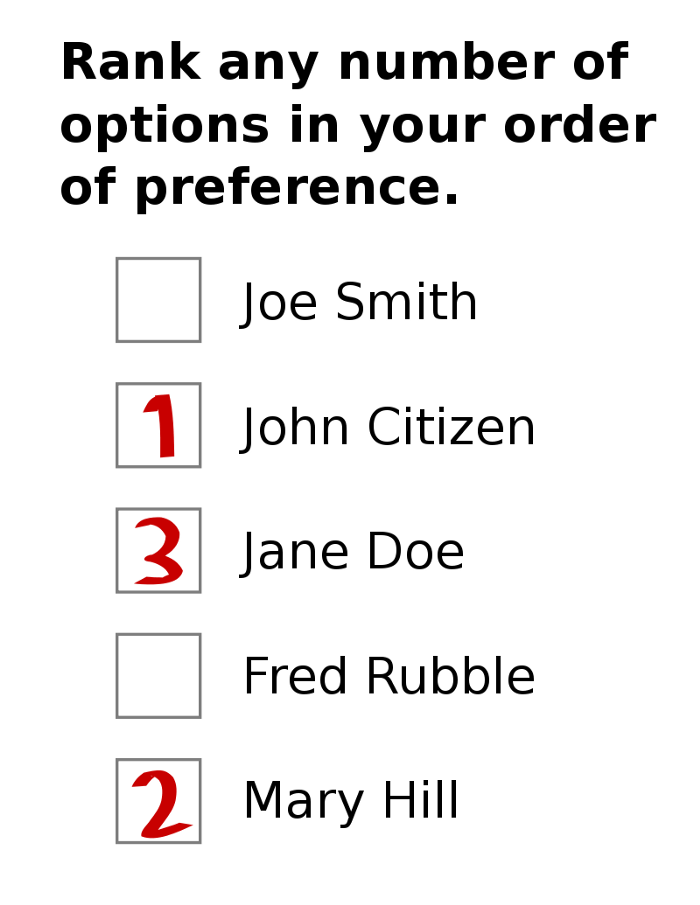
Mock STV ballot paper
For transparency, I am the Cambridge University UCU Branch President, but I am writing this blog in a personal capacity and the views expressed here do not necessarily reflect those of the branch.
Election time is upon us once again with a plethora of candidates for National Executive Committee (NEC) and associated positions standing on variety of manifestos. This blog is not about who to vote for, but HOW to vote using the STV system — if you don’t know how the system works, you could be voting for a candidate that you do not support.
The UCU website says, “Voters are asked to rank candidates in order of preference (1, 2, 3, etc.) until they can no longer express a preference.” But what does this mean? Does it mean that I have to rank all the candidates and fill every box on the ballot? Do I have to vote in the election for every position?
The simple answer to this question is no. But not only don’t you have to, you shouldn’t do that. Where the UCU instruction says until they can no longer express a preference I would take that to mean that if you would not prefer a certain candidate to get a vote — you should not list them. Don’t forget, in this system if you write a number — any number — next to candidate’s name on the ballot — they potentially get a vote.
On the Electoral Reform Society website, it says this, “Voters can put numbers next to as many or as few candidates as they like.” If you only have three preferred candidates, then only put 1, 2, and 3 into the table. If you only support one candidate from a list of eight, for example, then ONLY put 1 next to their name and leave the others blank.
Isn’t this breaking the system? I would argue that it is not. Every voter has only one vote but knowing how STV works means that you can control how that vote is used.
The Single Transferable Vote (STV) system is a type of proportional representation used in some elections, such as local government elections in Ireland and Australia. It is different from the traditional “first past the post” system we are used to in the UK, where voters choose one candidate and the candidate with the most votes wins. STV allows voters to rank candidates in order of preference. If a candidate does not receive enough votes to be elected, their votes are transferred to the next preferred candidate. This continues until all seats are filled.
Every position has a baseline quota of 1st Preference votes to reach in order to be elected. If a candidate meets that quota on the first round, then any votes for that candidate in excess of that quota get transferred to their expressed 2nd Preference. This could mean that despite one candidate getting many more 1st Preference votes and hitting quota, the 2nd Preference could overturn that win. And this works all the way down the line. If no candidate meets the quota, then the candidate with the least number of votes is eliminated and their preference votes are redistributed. There are different systems for how the redistribution works but essentially they are doing the same thing.
So be careful when you vote — but by all means do use your vote. To get the most out of the election, there are a few things you can do:
Research the candidates: learn about the candidates running in the election and their positions on the issues that matter to you. This will help you make an informed decision when ranking them.
Be strategic: Think about the chances of your first choice candidate winning and how your vote will transfer to your next choices.
Vote for a range of preferred candidates — don’t list those who you think should not get a vote. At the same time, lost seriously at second and third choices if available for each post.
Encourage others to vote: Get your friends and colleagues to vote, and educate them on the STV system if they are not familiar with it.
This meant to be a short blog with my recommendations on how to vote in UCU’s NEC elections, so I’m going to avoid writing a long preamble. I think that the union has been in a bit of a mess over the past few years, and I think that the best way of sorting this mess out is to try and elect new people to the NEC.
NEC ballot papers will start to arrive in the post today. These will include members election statements, but I know from experience that choosing how to cast your ballot can be quite daunting — election addresses are rarely direct, and you find yourself trying to judge a candidate’s political leanings by reading between the lines.
The following is a list of people that I think hold reasonable, pragmatic views on the key questions facing the union. They are people who — as far as I know — argued against the current NEC’s plan for indefinite strike action. Some of them I know personally, some I know from their social media presence. If I have misrepresented anyone in this list, then I am happy to amend it on request — and if any candidates want to make the case for being included, then they’re also welcome to get in touch.
If you’re a UCU member, please make sure to vote in these election, and vote for the candidates listed below.
Please, please, please, in the name of all that is good and holy, vote for Emma Battell Lowman for Vice President, and David Harvie for Honorary Treasurer. No second preferences. These are both vitally important posts, and we need to ensure that Emma and David are elected.
UK-elected members HE (4 seats; to include at least one post-92, one academic related)
Every HE member has a vote here, regardless of where in the UK they live.
Recommend that you rank 1st, 2nd or 3rd: Adam Hansen, Dyfrig Jones, Jak Peake
Recommend that you rank 4th, 5th, 6th or 7th: Francis Clarke, Rebecca Harrison, Chris O’Donnell, Caroline Proctor
Do not recommend that you vote for any other candidates
UK-elected members FE (2 seats)
Recommend that you vote for Jackie D’Arcy, and no other candidates
Representatives of disabled members (2 seats; one HE member and one FE member to be elected to include at least one woman)
Recommend that you vote for Bijan Parsia, Em Campbell and no other candidates
Representatives of LGBT+ members (2 seats; one HE and one FE member to be elected)
Recommend that you vote for Mark Pendleton and no other candidates
Representatives of black members (2 seats; at least one woman to be elected)
Recommend that you vote for Jak Peake and Victoria Showunmi, and no other candidates
Representatives of migrant members (2 seats, at least one non-EU member to be elected)
Recommend that you vote for Vivek Thuppil and no other candidates
Representatives of casually employed members (2 seats; one HE member and one FE member to be elected)
Recommend that you vote for Matilda Fitzmaurice and no other candidates
Geographically-elected members of the National Executive Committee
Midlands HE (3 seats)
Recommend that you vote for Emma Battell Lowman, Francis Clarke, Caroline Proctor and no other candidates
North West HE (2 seats)
Recommend that you vote for Philippa Browning and Michael McKrell as either 1st or 2nd preference
Recommend that you vote for Lucy Burke as 3rd preference, and do not vote for any other candidates
North West FE
Recommend that you vote for Helen Kelsall and no other candidates
South HE (4 seats to include at least one woman)
Recommend that you vote for Rebecca Harrison and no other candidates
South FE (1 seat)
Recommend that you vote for John Fones and no other candidates
Scotland HE — UCU Scotland President
Recommend that you vote for Chris O’Donnell as 1st preference, Jeanette Findlay as 2nd preference, and no other candidates
Honorary Secretary UCU Scotland
Recommend that you vote for Chris O’Donnell as 1st preference and no other candidates
The Campaign for UCU Democracy welcomes points of view on the democratic structures of the union and who would best serve the union in these positions. If you would like to comment on anything in Dyfrig’s post, please do so below.






 Campaign for UCU Democracy