Here We Go Again. You Tell Us

From Jak Peake

From his blog here.

Source: Flickr ©️ Marco Bellucci: Question Mark, Exhibition of Jean-Michel Folon, Forte Belvedere, Firenze

We have, one might argue, been here before. As of 24 March, UCU is consulting members as to whether we should be consulted on the UCEA and UUK proposals – prompted in part because of the unusual decision of the Higher Education Committee (HEC) to vote against consulting members in spite of the fact that 67% of voters in UCU’s national survey and 52% of delegates at a national Branch Delegate Meeting voted for consultation.

Some HEC members, most notably Vicky Blake, have offered a commentary as to why they voted against consultation at the special HEC meeting on Friday 17 March. The primary reason seems to be this: that there was “no option for HEC members to vote by dispute.” The combination, Blake continues, of this inability to consult on one dispute and not the other – say pensions, but not pay, terms and conditions – and the “flawed methodology and framing of the pre-HEC consultation processes”, prevented her from voting for consultation.

On this first point, this blog from UCU Commons HEC members contradicts Blake’s commentary, stating that the HEC Chair had advised HEC against splitting consultation on the pay and pensions disputes, but had not ruled it out:

…some other members of HEC wished to ballot members on the USS offer only, and [we] expected them to challenge the chair to try to amend this question. Challenges to the chair are very common in HEC, and can be made by interrupting business with a point of order … [However], this didn’t happen, but some UCU members are now under the impression that HEC was “prevented” from considering a ballot on USS only. HEC was effectively advised not to make this decision by the Chair and our supporting officials, but we can’t see how it was in any way prevented from doing so.

So, according to these Commons members, rather than challenge the HEC chair, and choosing to consult on USS, a majority of HEC members voted to reject consultation altogether (the HEC votes are visible here), cutting off one’s nose one might say to spite one’s face.

On the second point, there has been lots of consternation expressed about the consultation process which does appear problematic. When branch delegates initially voted on one question about whether the union should consult and pause, it appears that a majority voted against this option (though the weighted results of this vote have not been presented). It was only when the questions of pausing and consultation were separated that 52% voted for consultation. This, however, was not what branches had been instructed to consult on – the questions having been combined – and hence a number of delegates undoubtedly may have abstained when the questions were decoupled, making the results of the second round of questions problematic to say the least.

So, the consultation was messy – as has been acknowledged by Jon Hegerty, who has stated (via email on 22 March) that errors were made in terms of communications, and who has vowed to “try to get things right”. A national survey showed a 2:1 preference for consultation and pausing; a national BDM showed mixed results – no to pausing and consulting, but marginally yes to consulting and not pausing.

Still, with the flaws of the consultation factored in, some may be scratching their heads as to how HEC members justified a decision to not consult members on one or the other or both of the disputes. I would expect HEC members to at least anticipate the PR problem facing them after the 17 March meeting. How could the HEC vote against member consultation and still make a claim to respecting union democracy or being member-led (at least in the ways that many members in the union understand these terms)?

The answer from HEC members who justify the HEC vote of non-consultation seems to concern the framing of consultation, the sense that the proposals on pay and conditions in particular could be firmed up, and the lingering feeling that HEC/NEC members are not fully included in the devising and shaping of consultation questions – the latter of which Michael Carley touches upon in his response to me (originally in response to him). Presumably HEC members who voted for consultation, however, took a different view: that members broadly desired formal consultation on the employers’ offers on pay and pensions, that the proposals are serious enough to warrant consultation and that, on this basis, no amount of grousing about the mode of or flaws in consultation justified such a denial.

Given the preferences of members, I would have expected the HEC to have settled on consultation with or without a pause (even if consultation without a pause is costly and strategically unwise given that it places virtually no leverage on employers who would not on principle produce new offers/proposals while members consult on current proposals). So, too, did quite a few colleagues at my local branch, some of whom expressed consternation at the HEC decision which they read as high-handed and vanguardist.

On the evening of Friday 17 March, following the announcement of the HEC’s decision, I received the following email from a member of my branch:

HEC decide to continue but not to put it to the vote … This is incoherent and definitely is not listening to the membership however its voice is to be presented to the Union leadership. The only coherent response is to cross the picket line, with the only question being whether to resign from the Union first. … I [will] wrestle with that conundrum (never crossed a picket line before).

This was not the only email I received in this vein as Branch President at the University of Essex. It is hard to see how the HEC’s decision can be construed as anything but anti-democratic or “authoritarian” as another Essex colleague described it, though for its defenders – at least in one of several circulating open letters – the “e-survey was not a democratic exercise and was never intended as such, but was an attempt to manipulate the HEC”.

These are strong words from the defenders of the HEC’s decision which push towards what many members will see as a perverse or paranoid interpretation of events. Let us remind ourselves of the question members were asked: “Do you support UCU members now getting a vote on the negotiated proposals that have been reached, and pausing strike action (ASOS would continue) whilst this consultation takes place?”

I have fleshed out complaints about this question. But is such a question “manipulative”? Perhaps the real issue here is that there are lingering concerns that elected negotiators have not been properly consulted on the proposals, or indeed the pause which brought about ACAS negotiations, and therefore have been sidelined by a combination of the bureaucracy and the General Secretary’s team, and/or a section of the union’s leaders: what many tend to refer to broadly as HQ.

In all fairness, there may be something to this: the General Secretary, President Elect and national officials have put in time to produce a podcast and transcript which talks up the proposals while the elected/lay negotiators have not fed into these discussions or documents. In this respect, a fair assertion to make is that we have not heard fully from the whole negotiation team about the proposals. Rather we have heard from those who were involved in the ACAS negotiations. Is this proper? There is little to say it is improper. Some HEC members have complained about their prevention from making formal recommendations on the proposals if members are consulted on them. However, Hegerty has set out that it would not be appropriate for recommendations to be made on proposals which have not yet materialized into offers, and it would be at the offer/deal stage – further down the line – that the elected negotiators and/or the HEC could make formal recommendations. I cannot claim to know the mechanism by which the HEC can or typically make recommendations on proposals, but I see no reason to distrust an official or to see why one would be actively working against members’ interests.

Nevertheless, it is in context – one in which distrust is unfortunately pervasive – that three of the four lay negotiators on pay (Lucy Burke, Marian Mayer and Sean Wallis – a fourth Robyn Orfitelli being unable to comment due to personal circumstances) and the two HE vice chairs (Maria Chondrogianni and Deepa Driver) have published their thoughts about the employers’ proposals. Their main purpose may be to put the other side of the debate, the side missing one might argue from the relatively upbeat narrative of the General Secretary (GS), President Elect and others and perhaps even Jon Hegerty’s fairly neutral branch briefing slides on the offers, but it is hard not to see this as factional given that 4 out of 5 of the negotiating team represented are affiliated with UCU Left. I understand the impulse – but I am not sure at this point that a discussion of the proposals which they argue should use a 2020 offer rejected by members (so in essence a non-deal) as a baseline is helpful when what is facing members is whether they wish to be formally consulted on the employers’ proposals in the first instance. The question, then, ought to be not should we accept or reject these proposals, but do we think them good enough to consult on in the first instance and have further discussion about following formal consultation?

Some of us feel we’ve already stated our position on this, but this message has not been heard. Carley writes of me in the same breath as the GS, claiming that we “believe that if the NEC makes a ‘wrong’ decision, it should be bypassed”. This seems an overly literal reading of an article which was making the case to move beyond the binaries of direct vs representative democracy. In the context of the HEC not consulting members on indefinite action, I said that “‘direct’ democracy was the best recourse to put HEC members in touch [emphasis added] with real rank and file views”. I raised it as a justifiable “model” when, to quote Michael Abberton, “ideology overrides the democratic will or best interests of the [union’s] constituents”. I didn’t, however, say that direct democracy should be implemented formally, that e-consultation be made binding and turned into referenda, or that national committees or branch representatives should be bypassed; furthermore, I would advise against the sidelining of elected negotiators, and made the point that what transpired when the GS went to members was not in fact direct democracy, but rather consultation (to inform decision-makers within the union leadership) plain and simple – a mechanism used since UCU’s formation in 2006 and regularly adopted during Sally Hunt’s tenure as General Secretary. However, I do feel that when FEC, HEC or NEC or any other national or cross-committee ignores the will of the majority of its members, it invites inevitable challenges. And perhaps more significantly than coming from the GS, or HQ, these challenges will and do come from the frontline. Members who feel ignored or sidelined will not follow a diktat from on high. Rather they will cross a picket line or walk away from the union altogether.

Aside from the debates about union democracy, there are other key reasons why it makes strategic sense for members to consult on both of the current proposals. Firstly, it gives more time for proper debate of the proposals and allows a much broader spread of people to have their say beyond the forty odd members that make up the HEC. Secondly, if the membership accepts the proposals, it prevents a protracted period of loss of pay (at a time when loss of income is hard felt) and provides some kind of a win and respite from industrial action. Certainly, for those who are holding out for better offers/proposals and have sacrificed a lot, they may feel such a win a let-down, but if they are minority can they really set the terms for the majority of the membership? Thirdly, if we are to ultimately reject the proposals, the rejection will always be stronger – providing better leverage – if coming from the membership rather than the HEC. To paraphrase one HEC member who voted in favour of consultation on 17 March, not asking the membership is not a sign of strength, but of weakness.

What do YOU think?

From Michael Abberton

From Michael’s Medium blog here

Why is posing that question (see above) to UCU members in the current Higher Education dispute a problem?

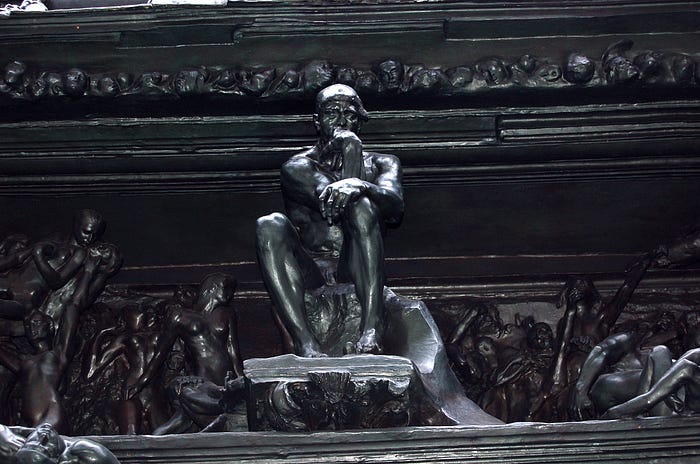
The Thinker — Detail of the Gates of Hell by Rodin — photo ©the author

Another week goes by and again UCU branches are in turmoil over another round of member consultation prior to another Higher Education Committee (HEC) meeting. Branches are being asked to consult members to find out what their opinions are in respect of how the current industrial action campaign should proceed. This exercise, through a national e-survey and also reporting through a Branch Delegates Meeting (BDM), has no constitutional standing and is only advisory to the HEC. But the primary point of contention seems to be not the content of what is being consulted upon — but whether the members should be even given the opportunity to express an opinion on whether there should be any formal consultation at this stage. Debates are being had about the nature of democracy, about the legitimacy of plebiscites, about the meaning of representative democracy at a local and national level in union organisation. What is going on?

The nature of the exercise

The national union, and it must be said local branches, needs to survey the membership on how they think the campaign should move forward. Should various aspects of the campaign, for example the USS Pension dispute, go to a formal consultative ballot on whether to suspend action based on progress to date? Such information is needed if we vote to continue the industrial action for another six months and would help to form strategy and format of what action should take place. Similarly, members are being asked about the start date of a proposed Marking and Assessment Boycott (MAB).

The union needs to know whether the action will be strongly enacted with the support of those members not directly taking part. Again this is important information, especially if the punitive lock-outs enacted by some establishments are adopted more widely, forcing members into indefinite strike action. At the same time, the MAB is our last resort, we know that this is damaging to students and could lose student and public support, not to mention those UCU members who will not support the action and may even leave the union in protest. It’s not something that we should do easily without considering all the ramifications.

So this is a survey asking members whether they want to be formally consulted on different aspects of the campaign. If the formal consultation goes out, it would be subject to rules, it would be accompanied by guidance and information from UCU HQ and local branches could also send similar advice to their members. What’s the problem with that?

Some members are arguing strongly that the survey should not be happening at all.

Members are arguing that only elected committee members and negotiators should have any say in union governance — whilst seeking to censure the elected General Secretary and further nerf the powers — and thereby the effectiveness — of that office. There is also the argument that any opinion or decision made in a survey or otherwise is only legitimate if it is the product of an informed, in person, debate. Whilst that might work as an ideal principle, in reality that is very rarely the case. We have limited time for a start, and whatever materials produced to inform the debate may themselves be skewed in one direction or another. In other democratic forums, not to mention the HEC itself, members have publicly declared their voting intention prior to the meeting — and indulged in triumphalism afterwards.

“Consultation should only be done via a branch meeting and motions.”

A branch meeting, even with the best will in the world and the statutory notice given, will only ever hope to be attended by a few dozen members. In my branch, the most I’ve ever seen was during the 2017/18 dispute when we had perhaps 10% of the members in attendance. Members are unable to attend for a variety of reasons, from simply not being able to get away from work to other responsibilities or access requirements. Mostly, when it comes to passing motions or making rule changes, we rely on quoracy — this gives a minimum number deemed to be sufficiently representative of the branch to say that any vote will be therefore legitimate. This is deemed acceptable in the passing of motions especially where prior notice is given to the members, so that they can make special effort to attend if they wish to support or contest that motion.

A motion is an instruction for someone to do something. These are typically arranged through inductive reasoning, starting with a factual base (this branch notes), to a statement of opinion and/or intent (this branch believes) to a resolution — so in essence who is being instructed to resolve the identified issue and how it should be resolved (this branch resolves). It is good for setting future policy and branch outlook on issues, to supporting different campaigns or making donations, or setting branch strategy. A motion has constitutional recognition, where an e-survey does not. Therefore, if the branch held an e-survey that was contradictory to the motion, the motion would take precedence even if the majority opinion was clearly against it.

In this current exercise, branches are being asked to find out what the opinions of their branch members are so that these can then be accurately reported by the branch reps at the BDM. But as we have seen, a branch meeting does not give the majority of the members the opportunity to participate. If a motion is passed, that could be used to dictate the way the branch delegates vote, but this can only reflect the opinions of those present in the meeting. Similarly, it would not be right for the branch meeting to use a motion to instruct members how to participate in a national survey or ballot. In the best case scenario, this would simply mean that the branch reports at the BDM would be inaccurate and therefore useless. In the worst case scenario, the democratic instruments of the union could be used to promote opinions that the majority of members do not share, the HEC takes the reports in good faith and makes unsupported decisions that alienate members and damage the union. The legitimacy of using a constitutional instrument to control or impose on something that has no constitutional standing should also be questioned.

The need for reliable consultation

For a representative democracy to function, the elected representatives need to be in touch with their constituents, they need to be informed about their opinions and their decisions should be shaped accordingly. These can be interpreted or actioned in reference to a declared set of beliefs or principles — this is how most of our democratic bodies work. However, when that ideology overrides the democratic will or best interests of the constituents, it ceases to be valid. The opinions of an ‘elite’, or of a chosen constituency, are taken to be superior, the people don’t really know what they want and so should be content to be ruled, the democratic mandate of given to the elected representatives when they took office is absolute. This is the way the Tory party is currently running the UK government, and we are seeing similar methods being employed in state government across the US.

Similarly we have seen the argument recently that only striking members and activists should have the right to decide how the campaign proceeds. The wider membership — those who do not come to meetings or do not openly participate in the industrial action — should be disenfranchised. This ignores the fact that the action would be impossible without the financial and other support of those members, as would the legitimacy of our recognition in collective bargaining in the first place.

Some branch execs are going one further, instructing members not to participate in the consultation process at all. This would seem to be an attempt to de-legitimise any results from the consultation — it could then be claimed that as an undetermined number of members chose not to take part, that the results are not representative. It seems odd that these same arguments are being made whilst they insist that only poorly attended meetings are truly valid.

Why would there be such a debate over the legitimacy of a survey or the option of a ballot if these things are there to either inform the constitutional democracy, or are already a part of the rights of members to be consulted? Fundamentally, this stems from a fear that the membership may vote to end one or both sides of the dispute. For some that oppose consultation, the enthusiasm or even obligation they feel to continue and protect the dispute may be well justified, especially where they have made considerable sacrifice in both time and salary to ensure the success and solidarity of the action. No matter how legitimate those views are however, the action cannot continue without the support of the majority, and the union has to abide by their decision. It is always better to end action by ballot if that is what the members want, rather than the action dwindling away through lack of support — which to all intentional purposes is a defeat.

There is little point in standing aloft the barricade — whilst colleagues are quietly dismantling it, taking their desks and chairs back to their offices, labs, libraries and lecture halls.

The union leadership, both at national and local level, need to find out what the members think. It’s that simple. If the union truly belongs to the members, then their right to be consulted should be respected the maximum number should be given the opportunity to participate and decide how the industrial action campaign proceeds from this point forward. Well-intentioned arguments can made be made to prevent or limit this, however the inescapable fact remains that without popular support, any proposed strategy, and the campaign itself, is doomed to fail.

UCU Higher Education Committee Election 2023: What Happened?

From Dai Moon

Many if not most UCU members will not be aware that the 2023 Officer and National Education Committee (NEC) election results were released this month. For those who are aware, there is no guidance to explain what these results may mean for the future direction of the union nationally.

Scrutineers’ reports show voter turnout for national seats coming in at 10.7% and HE Seats at between 12.3% and 13.4%, meaning there has been a slight improvement on the previous year’s turnout of 7.9%. Clearly, despite this small increase, there remains a disconnect between the wider membership and the union’s democratic structures.

A driving aim of the Campaign for UCU Democracy is making the union’s internal politics intelligible to the whole membership, rather than the smaller group of ‘intensely engaged’ activists only. This guest blog post aims to help towards this with an overview of the Higher Education Committee (HEC) results – a separate post looking at Further Education Committee (FEC) results will follow.

As outlined elsewhere, UCU politics is largely factional, with two major factions organised in the open and both running slates of candidates: UCU Commons (UCUC) and UCU Left (UCUL). Another tendency, currently lacking an organised factional identity (i.e. the old Independent Broad Left and/or UCU Agenda), is also identifiable both via a legacy of past memberships and a prominent set of voting recommendations in these elections, which might be labelled ‘anyone but UCUL’. Looking at these slates first, therefore, what is the current ‘balance’ on HEC?

Note: If I have incorrectly identified anyone, please comment and I will update and note corrections/updates!

THE ACKNOWLEDGED FACTIONS

UCUL had a clear slate: Out of the 23 candidates UCUL recommended (20 UCUL members and three non-members#) seven were elected, six of whom were re-elected*: Maria Chondrogianni*, Mark Abel*, Deepa Govindarajan Driver*, Marion Hersh*, Rhiannon Lockley*, Carlo Morelli and Aris Katzourakis*#. This takes their new membership to 10 on HEC (also including Julie Hearn, Peta Bulmer and Sean Wallis, but not counting Aris Katzourakis who was recommended, but not a UCUL member), down from 13.

UCUC had a clear slate: Out of the 13 candidates UCU Commons recommended for HEC (11 UCUC members and two non-members#), nine were elected, one of whom was re-elected*: Lucy Burke#, Matilda Fitzmaurice, David Harvie, Rebecca Harrison, Bijan Parsia*, Jak Peake#, Mark Pendleton, Caroline Proctor and Vivik Thuppil. This takes their new membership to 13 on HEC (also including Jo Edge, Emma Kennedy, Esther Murray, Emma Rees and Laura Campbell, but not counting Jak Peake and Lucy Burke who were recommended, but are not UCUC members), an increase from 10.

This means that UCUC now have more representatives on HEC than UCUL, a significant growth in the former (+2) at the expense of the latter (-3). These are the only two formal factions…

INDEPENDENTS pt.1

The rest of HEC consists of 19 independents. But this blanket label hides more than it illuminates. My next goal is therefore to try and drill further down.

This takes us to the third slate mentioned, recommended on Dyfrig Jones’s Medium blog, which is, as said, really an ‘anyone but UCUL’ slate that includes recommendations for independent candidates and UCUC members (pointing to an alliance on issues related to industrial action in particular). Some of those listed have in the past run-on IBL/Agenda slates (e.g. Ann Gow and Philippa Browning); however, not all these independents may consider themselves as IBL/Agenda, and their placement on the list was outside their control. Where there is a clear overlap, however, is with members of this slate and the host of this guest blog – the recently formed Campaign for UCU Democracy (CfUCUD).

The Campaign’s ‘Who we are” page is explicit that its members “do not consider [them]selves a faction, but rather a campaign group” and “welcomes UCU members of any stripe to join”, publishing pieces by UCU members who are unequivocally not part of CfUCUD or any other faction. Yet, the website also republished Dyfrig’s ‘anyone but UCUL’ slate (my characterisation); so perhaps the term factionette fits?[1] Either way, for our purposes here I’m assuming there’s a shared ‘vibe’ between those recommended on this slate, which means we might expect a particular voting approach on HEC, while respecting the sincerity of the independent identifications.

So, counting only those non-UCUC members listed: Out of the seven candidates recommended (excluding the 11 UCUC HEC candidates), five were elected, one of whom was re-elected: Philippa Browning*,Adam Hansen, Dyfrig Jones, Jak Peake and Jeanette Findlay. Of these, Browning, Jones and Peake are members of CfUCUD, as are existing HEC members Andrew Feeney and Ann Gow. Joanna de Groot is not a member of CfUCUD, but previously ran as IBL/Agenda. Jeanette Findlay and Adam Hansen both appear to have no links to CfUCUD or IBL/Agenda, so, excluding them from calculations, if we consider these independents as likely to vote together this would appear to constitute a grouping of six on HEC (compared to the previously estimated nine for IBL/Agenda).

Considering the overlap in recommendations as evidence of a broad alliance on many issues, this gives UCUC and IBL/Agenda Independents a combined 18 seats on HEC.

INDEPENDENTS pt.2

That leaves us with four independent candidates elected who have no factional recommendation (two of whom are re-elected): Vicky Blake*, Agnes Fluess, Vida Greaux*, Laura Loyola-Hernandez. Four independents have recommendations from different slates: Aris Katzourakis from UCUL, Lucy Burke from UCUC, and Jeanette Findlay and Adam Hansen from the ‘not-UCUL’ slate. They join Kyran Joughin, Linda Moore, Justine Mercer, Grant Buttars and Rhian Elinor Keyse also elected as independents.[2] That amounts to a remaining thirteen ‘unaligned’ independents.

This again, however, hides a lot. Recent months have seen UCUL able to win votes at the HEC with the support of independents – notably the first vote for indefinite strike action, and more recently the decision to not consult the UCU membership on the USS and 4Fights deals. In essence, some members of the current HEC who are genuinely independent from UCUL still tend to vote with them (again, there is a shared ‘vibe’ on key issues). This is significant considering the number of independents re-elected. Nevertheless, lacking individual voting information from HEC, the question of identifying what tendencies may exist amongst independentsis difficult. Candidates do not necessarily consent to being named on different voting lists, for example, and either way, alliances can change over time – none of this is necessarily fixed. Relying on other proxies, such as past statements of support may help but also isn’t a given; e.g. Grant Butters, Kyran Joughin and Linda Moore all signed a letter supporting Jo McNeill as UCUL candidate for VP – then again, so did Jo Grady!

CONCLUSIONS

As an interim conclusion, what we might note is that after this election, for UCUL to outvote the seeming UCUC/IBL/CfUCUD block, they will require nine of these ‘unaligned’ thirteen independents to vote with them. Whether those numbers exist is something that we will all discover when the new HEC commences.

Essentially, therefore, this election must be counted as a bad election for UCUL and a good one for UCUC. It also illustrates the importance of HEC reforms that allow members to see how their elected members vote – e.g. whether tending towards one faction or none – to be able to hold them to account, and to make sense of what it is going on ‘nationally’.

Here is my calculation, if anyone refutes their placement, please correct me:

MemberFaction / Tendency
Maria ChondrogianniUCUL
Mark AbelUCUL
Peta BulmerUCUL
Deepa Govindarajan DriverUCUL
Marion HershUCUL
Julie HearnUCUL
Rhiannon LockleyUCUL
Carlo MorelliUCUL
Matt PerryUCUL
Sean WallisUCUL
David HarvieUCUC
Laura Chuhan CampbellUCUC
Joanne EdgeUCUC
Matilda FitzmauriceUCUC
Rebecca HarrisonUCUC
Emma KennedyUCUC
Esther MurrayUCUC
Bijan ParsiaUCUC
Mark PendletonUCUC
Caroline ProctorUCUC
Emma ReesUCUC
Vivek ThuppilUCUC
Philippa BrowningCfUCUD
Andrew FeeneyCfUCUD
Ann GowCfUCUD
Dyfrig JonesCfUCUD
Jak PeakeCfUCUD
Joanna de GrootIndie (IBL/Agenda)
Vicky BlakeIndie
Lucy BurkeIndie (UCUC rec)
Grant ButtarsIndie
Jeanette FindlayIndie (IBLish rec)
Agnes FluesIndie
Vida GreauxIndie
Adam HansenIndie (IBLish rec)
Laura Loyola-HernandezIndie
Justine MercerIndie
Linda MooreIndie
Kyran JoughinIndie
Aris KatzourakisIndie (UCUL rec)
Rhian Elinor KeyseIndie
Table of UCU Factions and Tendencies

[1]As someone who does not consider themselves part of IBL/Agenda or indeed any faction, but supports the Campaign for UCU Democracy’s broad campaigning aims, I’d like to think I offer some counter to the notion it is a proxy for the former faction(s).

[2]Note: the article originally stated that Grant Buttars and Rhian Elinor Keyse were re-elected, when in fact they are entering the second year of their first terms as HEC members.

Does HEC listen to UCU members?

From Adam Ozanne

The decision by HEC on Friday 17th March not to consult UCU members on the UCEA and UUK offers on Four Fights and USS – despite an informal 48-hour e-survey of members and BDM held the day before both showing majorities favouring consultation – has caused consternation and a storm of social media criticism of the General Secretary, of the way the e-survey and acrimonious BDM were conducted, and of HEC.

HEC’s decision raises issues that are fundamental to union democracy. Without going into whether the UCEA and UUK offers should be accepted or rejected or the arguments over the design of the e-survey questions and how the BDM was used to (as HESC motions put it) “give a steer” to HEC, we believe UCU members have the right to know how their elected representative on HEC voted on this crucial question regarding consulting the membership. Therefore, for the sake of transparency, democracy and accountability, we – that is those supporting the Campaign for UCU Democracy – publish below how we understand individual members of HEC voted.

First though, here is a reminder of the results of the e-survey and BDM. Individual members and branch delegates to the BDM were asked to answer “Yes” or “No” to the following question:

“Do you support UCU members now getting a vote on the negotiated proposals that have been reached, and pausing strike action (ASOS would continue) whilst this consultation takes place?

Informal e-survey results

Turnout: over 36,070 members voted, that is around 50% of HE members.

  • 67% were in favour of consulting members
  • 33% were opposed to consulting members

BDM results

  • 52% were in favour of consulting members
  • 32% were opposed to consulting members
  • 16% abstained from the vote

HEC was advised by Jon Hegerty, UCU’s Head of Bargaining, that if they voted for a formal consultation, members would be balloted separately on the USS and 4 Fights disputes; and was then invited to vote on the following question:

“Should the proposals agreed with UCEA and UUK relating to the USS and Four Fights disputes be put to UCU HE members in a formal consultation?”

19 members voted “Yes” and 22 voted “No”. We believe this is how individuals voted but any member of HEC whose vote has been recorded incorrectly may leave a reply in the comment box below and it will be changed. (N.B. One member of HEC, Robyn Orfitelli, was absent.)

For consulting membersAgainst consulting members
Justine MercerVicky Blake
Steve SangwineMarian Mayer
Victoria ShowunmiBee Hughes
Ben PopeKhizer Saeed
Emma ReesJulie Hearn
Jo EdgeMaria Chondrogianni
Emma KennedyKyran Joughin
Esther MurraySean Wallis
Emma Battell LowmanRhiannon Lockley
Chris GrocottMatt Perry
Laura Chuhan CampbellSaira Weiner
Joanna de Groot  Linda Moore
Philippa BrowningAnn Swinney
Sally PellowDeepa Govindarajan Driver
Lena WånggrenAris Katzourakis
Ann GowMark Abel
Andrew FeeneyVida Greaux
Bijan ParsiaGrant Buttars
Chris O’Donnell  Peta Bulmer
Rhian Elinor Keyse
Marion Hersh
Lesley McGorrigan
HEC Votes for HE Member Consultation on UCEA and UUK Offers

To those who follow NEC elections carefully and who have read An un-common guide to UCU’s NEC elections, factions, slates and independents, it will be apparent that the “For” column consists of those elected from the UCU Commons and UCU Agenda/Independent Broad Left slates plus one independent, Lena Wånggren, while the “Against” column consists of fourteen members of the UCU Left faction plus eight UCU Left-leaning independents (“UCU Left-Lite”, perhaps). The “Againsts” also include at least six (Sean Wallis, Saira Weiner, Bee Hughes, Mark Abel, Matt Perry and Julie Hearn)[1] current or past members of the Socialist Workers Party which set up and controls UCU Left – see UCU Left, the Socialist Workers Party and National Executive Committee Elections.

A more detailed account of the e-survey and BDM, the UCEA and UUK offers and the HEC meeting, including a copy of the advice given to HEC by Jon Hegerty and motions they will submit to HEC on March 30, has been provided by UCU Commons members of HEC and can be found here.

An open letter has also been produced by UCU members of Campaign for UCU Democracy and UCU Commons, calling for member consultation on the UCEA and UUK offers on pay and conditions and the USS pension respectively. Those minded to call on HEC to offer member consultation on the offers may wish to sign it.

[1] Note: Grant Buttars was mistakenly included in the original list of current or past SWP members above. Grant is in fact a member of Revolutionary Socialists of the 21st Century (rs21), which was set up by former members of the SWP after the 2012 Comrade Delta affair (Kelly, John. Contemporary Trotskyism: Parties Sects and Social Movements in Britain. Abingdon, Oxon: Routledge Taylor & Francis, 2018: p.68), but has never been a member of the SWP. My apologies to Grant for the misunderstanding.

Sign the UCU Open Letter – Member Consultation on Employer Proposals

UCU Open Letter: HEC to Consult Members on Employer Proposals Now

We, the undersigned UCU Higher Education (HE) members, call on UCU’s Higher Education Committee (HEC) meeting on 30 March to consult with HE members on whether the current employer proposals on pay, terms and conditions, and USS pensions are sufficient to settle our current disputes and/or suspend/call off future industrial action.

The consultation, in the form of an e-ballot, should include several questions. For example, it should include separate questions asking whether members are in favour of accepting or rejecting UUK’s offer on USS and UCEA’s offer regarding the Terms of Reference for joint union/employer reviews of pay, contract types, workloads and pay gaps. In this way, the two disputes can and should be treated, and consulted on as individual, separate disputes.

The consultation should also ask whether members would support the suspension of further industrial action whilst time-limited negotiations are conducted.* 

We would also ask that the HEC makes a decision that reflects the preferences of UCU members. Members take industrial action, and it is members’ views that should determine our industrial action policy.

We urge HEC members to vote for the following motion, supporting consultation on both disputes (pay and pensions), which is being taken to HEC on 30 March.

Click here to see signatories of the Open Letter and here to sign the letter.* 

*Please note: if you sign, only your name, title, Department/School/area and workplace will be shared in the list of signatories below. Note: we have cut the line ‘i.e. whether they favour the “bank and build” approach outlined by the General Secretary’ as it is not crucial to the aims of this open letter and motion, the latter of which is calling for a neutral presentation of the UCEA and UUK offers.