
From Jak Peake
From his blog here.
TLDR: Michael Carley outlines two opposing visions of union democracy, “representative” and “direct”. I explain here why I think this is a false dichotomy, that the essence of union democracy ought to reflect the broadest possible participation of members in decision-making, and that representative structures which do not exhibit high levels of member engagement cannot claim to be truly democratic. I also examine recent Higher Education Committee (HEC) and National Executive Committee (NEC) minutes to uncover some of the recent power struggles taking place among UCU’s governing bodies and figures.
Amid the tempestuous few days following the decision to pause strike action on the basis of Advisory, Conciliation, and Arbitration Service (ACAS) talks continuing between the employers’ body, UCEA, and UCU, various bloggers have had their say on the union’s rules concerning this pause and the agreement that has been struck between employers and the five Higher Education (HE) unions (UCU, UNISON, Unite, EIS and GMB). Of these a few consider the necessity or value of such a pause in light of the employers’ agreement, and the stakes and, indeed tensions, concerning different approaches to union democracy.
For the purposes of this piece, I want to focus on a recent blog by Michael Carley, in which he considers two contrasting interpretations of what a “member-led” union means. In responding to this welcome contribution to the current debate, I will aim to tease out some nuances with respect to “member-led” democracy and some other terms, “representative” and “participatory” democracy, while touching on wider points concerning union strategy, mobilization and member engagement. I also examine recent Higher Education Committee (HEC) and National Executive Committee (NEC) minutes to uncover some of the recent power struggles between UCU’s NEC/HEC and the General Secretary (GS) which feed into the debate about “representative” and “direct” democracy.
“Representative” vs “Direct” or Narrow vs Broad Participatory Democracy
In his recent blog post on member-led democracy, Michael Carley outlines two competing visions of how unions like UCU interpret the term “member-led”, with it roughly carving up along the lines of “representative” and “direct” democracy. Carley offers this brief summary of the preferred modes of different wings of UCU:
UCU Left favour decision-making through the union’s democratic structures, as informed by branch meetings and Branch Delegate Meetings, which give a steer to the national bodies which have the responsibility for decisions; UCU Commons and Independent Broad Left favour using consultations with all members in a sector, usually by individual electronic ballot, to inform decisions. Both approaches have their merits, depending on your view of what a trade union is, and how it should work.
Broadly speaking, this is a decent-ish, if slightly binary, working summary (to which I will return), if in need of a slight update in that Independent Broad Left (IBL) does not currently exist as a group, though some of its members were associated with UCU Agenda and now, in part, the Campaign for UCU Democracy group; furthermore, while the Campaign group considers e-consultation a key tool for union democracy and mobilization, it is not clear whether all those in UCU Commons necessarily agree, or not so straightforwardly. UCU Left initiated and directed by the Socialist Workers Party, tend to define their preferred style of democracy as “participatory” – where the votes in branch meetings are prioritized – as opposed to “plebiscite” – where polls are used for example to determine branch policy.
What Carley’s and UCU Left’s overviews do, however, is present these modes as binary, or near-binary, oppositions. This need not be, and often is not, the case. For instance, most groups who favour member e-consultation, generally do not see this as a replacement for branch meetings or debate. Even if say a branch e-poll is given primacy over a vote held in a branch meeting, it will typically be done on the grounds that the numbers of members completing the poll far outweigh the numbers of attendees at a branch meeting. Polls can also inform branch meetings. Hence when say 3-5% of branch members make it to a meeting, but a poll shows what around 30-35% of the branch members think, decision-making within the branch is strengthened by evidence of the general lay of the land.
From this perspective, use of e-consultation is rather a supplementary form of participation, not a dislocated plebiscitary exercise, which ensures activists (who usually turn up to branch meetings, demos and picket lines) as well as rank and file members have their say. E-consultation then from this lens really ensures broad participation in union activity beyond the small coterie of activists that tend to lead branches. What UCU Left tend to advocate for is a form of democracy that prioritizes the views of those – to borrow from Lin Manuel Miranda – in the room where it happens.
In doing so, they cut out the views of those outside the room and who don’t or can’t attend branch meetings. In an age where accessibility is rightly given pride of place, we might pause here to think why any group would champion a form of union democracy that excludes those who are unavailable for a meeting for whatever reason. Given the stretched workloads, busy timetables, care responsibilities and access needs of staff in HE, why wouldn’t we make the terms of union debate available to those outside a meeting?
Carley goes on to imagine the union in terms of branches and individuals and makes a strong defence of branches as repositories of “collective” organization over that of “atomized” individuals – championing branch democracy, a “representative” model over a “direct” one. The notion that branches represent collective organization in contrast to individual members, who are atomized suggests that when I think as a member, free from branch influence, I am an isolated individual, but when I act within branch structures, I represent the collective. Can individual members not also have a collective mindset? Individualism need not necessarily lead to a low-risk, self-centred mentality in which one shops around for the equivalent of the cheapest car insurance. Perhaps we should begin rather to re-frame the binary debate not in terms of representative vs direct democracy (or participatory vs plebiscite), but rather in terms of narrow and broad participatory democracy. If I have to choose between the two, I will opt for the latter every time.
When “Representative” Democracy is Not “Representative”
In part, Carley’s piece presents a not-so-veiled critique of the GS: too often, it is implied, she has bypassed the democratic structures of the union, namely the NEC and, by extension, the branches. To illustrate his point, he provides the example of when on 30 January the GS emailed HE members to participate in an online ballot to reject the pay offer made by the employers after the HEC had chosen not to put the offer to members, because it believed the offer insufficient.
To read the GS’s poll as an undermining of HEC decision-making is an over-determined reading of two approaches that were not discrepant; it also misses the over-arching strategic advantage of putting the employers’ offers to members (even when union leaders do not recommend their acceptance). The GS encouraged members to reject the offer in line with the HEC’s decision – in no way undermining the HEC. Some might have read this as an unnecessary risk or indeed “a distraction” as I recall one UCU HEC member saying, which could have potentially undermined the HEC’s decision. However, the key thing the GS wanted to anticipate and defend against was an easy offensive from the employers’ body, UCEA, that the offer had not been put to members. She did this, some might say by the backdoor, informally, but in doing so she shored up the union’s position against oncoming salvos.
In conceiving of branches as places of collective organization and extending this idea or metaphor to national democratic processes of the union, Carley presents us with an ideal that sounds great in theory, but which has not proven great in practice. In contrast to the critique of the GS’s attempts at direct democracy, we do not hear about what happens when “representative” democracy ceases to be “representative”.
The minutes for the HEC’s 3 November meeting make for interesting reading on this score – as we now have a little more insight into the HEC’s vote for indefinite action – a vote which proved to not be backed by branch delegates, members’ representatives. 3.16 of the minutes note Robyn Orfitelli’s objection to legal advice on the grounds that “it had not been offered to her or HEC at an earlier point”, while 3.17 shows the motion for indefinite action was carried in spite of a note “that members have not been consulted on this strategy”. Here, to my mind, is a clearcut case of when “representative” democracy failed the union in practice. Legal advice and evidence of member support for the strategy were dismissed in one foul swoop.
It was the HEC’s catastrophic misjudgement of both the union’s ability to sustain and members’ support of such action, which led to the GS proposing an alternative 10-day escalating strategy for members to vote on at a branch delegate meeting (BDM) on 10 January 2023. The results showed 57% of branch delegates supported Grady’s strategy. Here, she had challenged the union’s democratic structures and gone to members, but she had done so on good grounds. The HEC had opted for a radical course of action, ignoring the principle of accountability to the broad membership. In doing so, the HEC had ceased to be “representative” – a point currently glossed by UCU Left reportage, which makes no mention of the 2:1 preference among branch delegates for escalated action, but rather misleadingly pitches indefinite action as a battle of wills between the HEC, who voted for it, and the GS, who opposed it. In this instance, “direct” democracy was the best recourse to put HEC members in touch with real rank and file views; nevertheless, while the GS made her appeal to members directly, she actually relied on a system of “representative” democracy – as BDMs rely on branch delegates – to report back, hence used two participatory models.
Many may recall the release of the GS’s escalating strategy via Youtube video on 14 December and wonder about her rationale for this step. On the surface, this might be read as evidence of the GS’s undermining of the NEC (albeit on the grounds that the broad membership could have its say). UCU Left’s website describes it as a “wholly undemocratic” intervention. Yet, there were clear tensions at work here, a backstory of the NEC’s attempt to muzzle the GS albeit in a surreptitious, almost imperceptible way. Few may have understood the inference near the start of the video, in which Jo Grady mentions that due to an NEC decision she “no longer provide[s] an in-person update” to the NEC. What did this mean? In short, the NEC had decided back in 17 June 2022 that it did not want to hear her reports in person, but wanted them recorded in advance – in essence cutting down her talking time within the meeting while making her available for questioning. The ostensible reasoning for this in the NEC motion that passed concerned time saving measures. It’s possible of course that some in the room voted for the motion in good faith, believing it a helpful time-saving measure; nevertheless, this manoeuvre does not look entirely innocent either, and betrays a broader struggle for power taking place between some NEC members and the General Secretary, whereby the former have sought to clip her wings.
In the penultimate paragraph of his 18 February blog on “member-led” democracy, Carley makes a veiled comment on the process by which the “pause” was brought about: “this week, NEC members have supported the decision to conduct negotiations with employers without consulting the people branch delegates [elect] to negotiate for us”. This sentence says a lot without appearing to. He correctly assesses the issue which has prompted outrage this and last week: that the GS, Jo Grady, and President Elect, Justine Mercer chose to suspend action to see through talks in concert with the four other HE unions. He is undoubtedly right to ask (without actually asking) why other JNCHES negotiators were not consulted, and to pose this question to members. However, if the inference is that this is an injustice to branch organization which undermines “representative” branch power this is debatable. In the annual HE sector conference, for example, held around May/June, voting branch delegates elect four of the JNCHES negotiators (the other four comprising the HEC chair, two HEC vice-chairs, pre-92 and post-92, secretary of HEC/UCU), but few if any branches that I know of give guidance as to which negotiator a branch delegate should choose – with guidance generally only given, if at all, concerning certain key motions important to the branch.
The process by which we elect negotiators at special sector conference is more likely to come down to whoever happens to be in the room – whether it is someone trusted by the branch, or the person who says “yes” and is willing to give up a day or two to sit, listen and vote on a series of motions. The point is the system by which we elect these four negotiators is reduced to a few hundred selected branch members, instead of the several thousand members it could be opened to. It seems appropriate to define this difference as not so much between “representative” and “direct” democracy, but rather between narrow and broad participatory democracy.
Fixing the Root Cause: Towards Higher Member Engagement
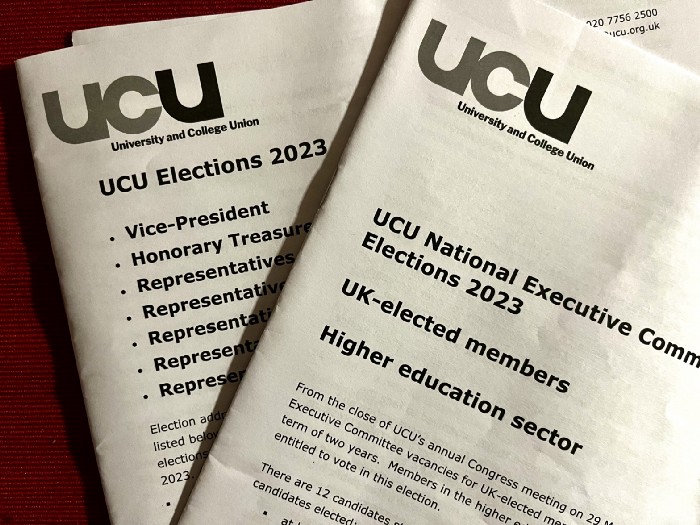
One of the reasons UCU’s national committee members may not always be so “representative” of rank-and-file members may be in part due to the low turnout of UCU members in NEC elections. In the 2021-22 UCU trustee, officer and NEC elections turnout was 7.9% – roughly a quarter of the underwhelming turnout of the 2021 England and Wales police and crime commissioner elections. In this context, then, it is not hard to see why the union’s democratic structures are populated by many people who either do not represent, or who are not necessarily interested in, the “mass line” or broad view of members. At the more local level, branch general meetings are often attended by only a small proportion of members – typically only scraping over the minimum number for quoracy, sometimes failing to do so – with branch committees rarely elected (since there is almost never competition for places). If “the union’s structures… informed by branch meetings” are to be taken seriously (as an alternative to direct consultation) then we need to ensure that they actually involve the broad membership in some way – if not inside the meeting, then outside – with e-consultation just one tool to do so. If we had higher member engagement in branch structures and NEC elections, and more democratic openness in terms of what happens in UCU’s various national, cross-sector, regional and branch committees, then we might get stronger representative democracy; e-consultation itself, while allowing individual members to be heard and avoiding activists speaking over the heads of the collected membership, might also be used to mobilize members on specific issues. Indeed, to some extent, paper balloting of members at periods of getting the vote out – comparable to e-balloting if more labour intensive – often does exactly this.
As one colleague recently put it, it’s possible our focus on differing interpretations of “member-led” democracy centres too much on the symptoms and not the cause – the cause being too few UCU members engage with UCU’s democratic structures in the first place. If, then, we really want to fix the democratic deficit within the union, then it’s this – member engagement in UCU’s democracy – that should be a top priority. E-consultation is certainly part of the equation for fostering broader membership engagement, but it cannot be the whole story. We need to look at UCU structures, re-think the rules on elected positions which rely on less than 1% of the membership voting, make UCU committee documents and actions easily accessible, and encourage members’ ownership of and engagement with not just industrial action, but with the crucial events and fora – elections, Congress, sector conferences, UCU’s national and cross-sector committees – which serve as the essential organs and lifeblood of union democracy.







 Campaign for UCU Democracy